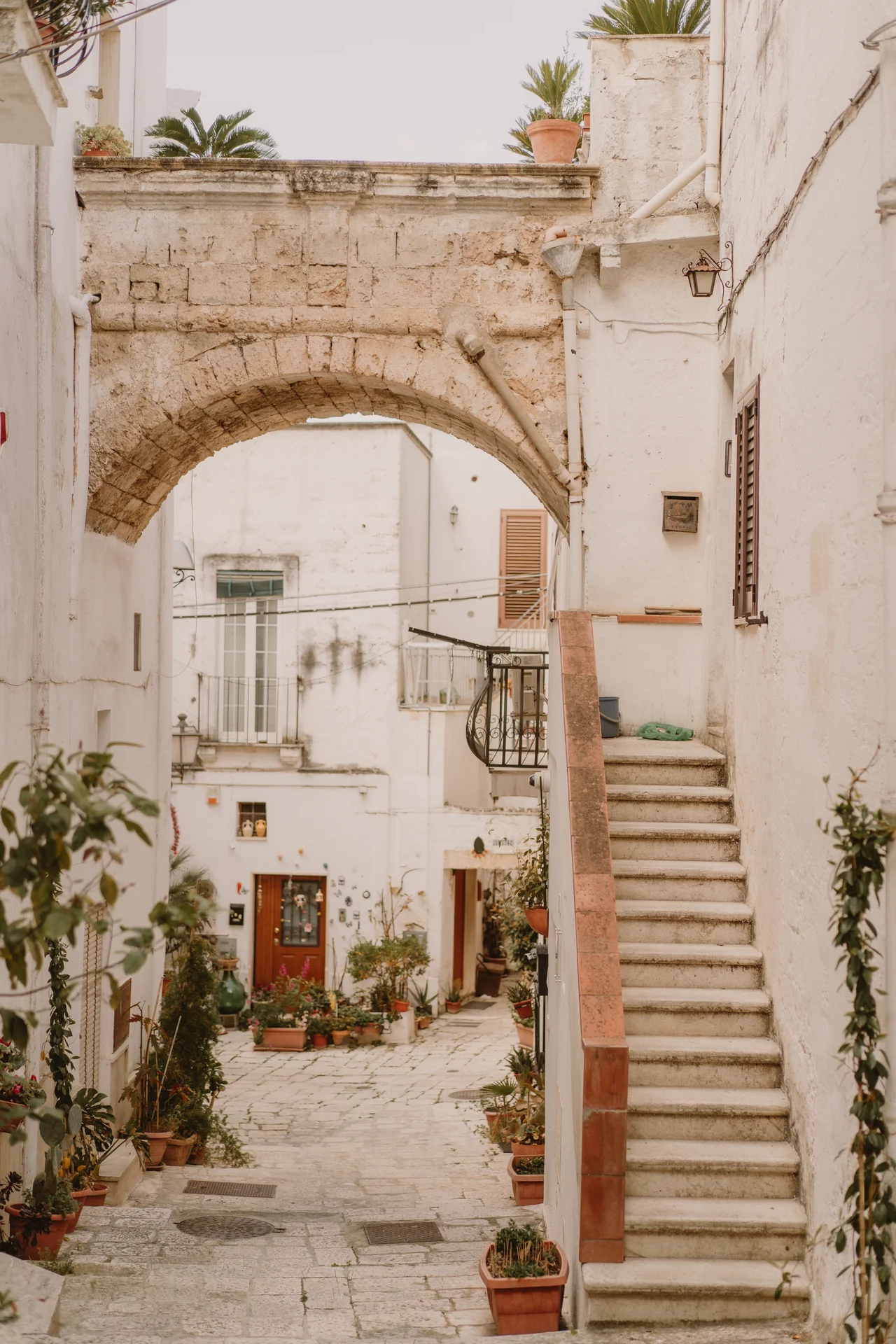
Corni di Fiasco · The area · Puglia in the plural
Welcome to the Puglias
Less than half an hour from Corni di Fiasco, in San Marzano, the old folk speak Albanian. Two hours away, in Bari, the fritter Lecce calls pittule becomes popizze, and the vowels at the ends of words disappear. An hour and three quarters the other way is Matera: another region, but until 1663 the same province as Maruggio. In between, the colour of the stone changes, and the shape of the roofs, and the day you fry it.
That is why we say le Puglie: the Puglias, in the plural. It is not an affectation: laws, newspapers and encyclopaedias used it until the middle of the twentieth century. Puglia as the only name, in the singular, is a recent thing, and once you have driven around a little you see why.
The stories closer to home – Messapians, Saracens, knights and towers – are in the Stories of Maruggio and beyond. Here we get in the car.
Puglia, Apulia, “le Puglie”: why the plural
In 1898 Parliament passed a law “for an aqueduct in the Puglias”, and Bari’s newspaper had been founded a few years earlier as the Corriere delle Puglie. Between 1909 and 1911 the state published an inquiry into the peasants of southern Italy: one volume is called Puglie, the one beside it Calabrie, both in the plural. The singular took over with the Republic.
The reason is plain on the map: there were three Puglias. Capitanata: Foggia, the Tavoliere and the Gargano. Terra di Bari: the coast and the Murgia plateau. Terra d’Otranto: the whole of the south, from Taranto to Leuca.
And before that there were three peoples. The ancients called the people here Iapygians, and divided them into Daunians in the north, Peucetians in the centre and Messapians in the south. For the Romans the name Apulia belonged to the north; Salento was called Calabria. Later the name emigrated across the gulf, to the toe of the boot, and never came back.
From the Gargano to Leuca: the regions of Puglia, north to south
From above, Puglia looks flat. It is not. At the top is the Gargano, limestone riddled with thousands of sinkholes, and a real forest, the Foresta Umbra, a stone’s throw from the sea; beside it the Monti Dauni, the region’s only mountains, which just top a thousand metres. Below lies the Tavoliere, the great plain of Foggia: a granary, and winter pasture for the sheep of Abruzzo.
Further south, the Murgia: a plateau of stone, pasture and dry-stone walls, where water vanishes into the limestone and reappears in caves. Towards the sea, Terra di Bari, with its cathedrals on the waterfront. In the heart of the Murgia of the trulli lies the Valle d’Itria, the Itria Valley, which is not a valley at all: it is a karst basin on the plateau, and the name probably comes from a Byzantine Madonna, the Hodegetria, “she who shows the way”.
Then the Ionian arc, with the gravine, the ravines cut into the rock from Massafra to Laterza. Between Taranto and Brindisi the land drops, and from there south it is Salento. Ours. Here the hills are called serre and barely reach two hundred metres, and the land ends at Leuca, between two seas.
Horace, who came from Venosa, just next door, called it siticulosa Apulia (thirsty Apulia). He was right: rivers are few, and for its drinking water Bari had to go all the way to Campania, to the springs of the Sele. The main channel of the Acquedotto, over two hundred kilometres long and much of it tunnelled through the mountains, falls just forty-five metres along its whole length. Today the springs supply about a third of the water; most of the rest comes from the reservoirs of Basilicata.
| Area | Where | What gives it away | From Corni di Fiasco |
|---|---|---|---|
| Gargano and Monti Dauni | the north, above Foggia | the forest, the cave of San Michele, Franco-Provençal at Faeto | about 3½ hours |
| Tavoliere | around Foggia | the plain, the wheat, the tratturi | about 3 hours |
| Murgia and Terra di Bari | from Barletta to Monopoli and inland | the Romanesque cathedrals, Castel del Monte, the jazzi sheepfolds | about 2 hours |
| Valle d’Itria | Martina Franca, Locorotondo, Alberobello | the trulli, the white towns, capocollo | 1 hour · trulli in the hills or by the sea? |
| Ionian arc and gravine | from Taranto towards Matera | the rock-cut churches | Taranto, with the MArTA, 30 minutes away |
| Salento | from eastern Taranto province, through Brindisi and Lecce, down to Leuca | the Baroque, Griko, the pajare, the pizzica | Lecce 1 hour, Leuca 1½ hours |
The Valle d’Itria is not Salento: it is on the Murgia, and Salento begins further south, beyond Taranto and Brindisi. Corni di Fiasco is on the Salento side, an hour from the Valle d’Itria.
Daunians, Normans, Swabians: a history of Puglia
Nearly everyone has passed through this thirsty land, and nearly everyone has left something in the dry-stone walls. The farmers of the Siponto plain had reused the Daunian stelae – stone slabs carved with warriors and bejewelled women – in their walls and their stable floors. At Egnazia you walk on a stretch of the Via Traiana, still rutted by cart wheels. On the plain of the Ofanto, on 2 August 216 BC, Hannibal destroyed the Roman army at Cannae.
After Rome the region split in two: Lombards in the north and inland, Byzantines in the south and on the coast. For some twenty years, in the ninth century, Bari was an emirate, and its last emir, taken prisoner, ended up as adviser to the Lombard prince who held him prisoner. Then the Byzantines came back and made Bari their capital in Italy, then came the Normans, and in 1087 some sixty sailors from Bari went to Myra, in Asia Minor, and came home with the bones of Saint Nicholas.
Frederick II, who was born in Jesi, chose Puglia: a palace in Foggia, of which just an arch with two eagles survives; castles everywhere; and at Lucera a city of Saracens deported from Sicily, which the Angevins wiped out in 1300. The Angevins also left behind a language: it is thought that Faeto and Celle, in the Monti Dauni, were founded by the descendants of soldiers who came from beyond the Alps to garrison a fortress, and Franco-Provençal is still spoken there.
In 1480 the Ottomans took Otranto. A few years later Venice helped itself to Trani, Brindisi and Otranto as security for a war debt, Albanians were arriving from the far shore, and then came two centuries of Spanish viceroys, and with them the Baroque.
The dialects of Puglia: two families and three languages
Nobody in Puglia speaks “Apulian”: the dialects of Puglia fall into at least two families. In the north and centre they belong with Neapolitan and Abruzzese, with final vowels that get swallowed and middle vowels that change from one town to the next: between Trani, Ruvo and Martina Franca, the word for spindle, fuso, has three different pronunciations. In Salento they speak something else, closer to Sicilian and Calabrian: five full vowels, the dd of beddu and cavaddi, and a verb that will not take the infinitive. You do not say “I wanted to know”, but ulìa cu ssacciu, “I wanted that I know”, a habit linguists trace back to Greek.
Between the two there is no line but a band, and it runs right between Taranto and our house: in Taranto they speak a border dialect, in Maruggio one sentence is enough to hear Salento. The rest of the match between Taranto and Lecce is in the Stories.
Then there are three languages that are not dialects. Griko, in seven villages of the Grecìa Salentina, between Lecce and Otranto, plus two more where it now barely hangs on: a form of Greek with a thousand years of its own history, not the language of Pericles. Arbëresh, or arbëreshë, the Albanian brought over in the fifteenth and sixteenth centuries: at Chieuti and Casalvecchio, in the province of Foggia, and at San Marzano, where an Albanian nobleman bought the fief in 1530 and repopulated it with his own people. The Franco-Provençal of Faeto and Celle, cut off from its homeland for seven centuries.
All three are protected by law. Griko and Arbëresh are spoken mostly by the old; in Faeto and Celle, Franco-Provençal is still the language spoken at home.
Trulli, cathedrals and Baroque: the stone changes
Just look at the walls. In the north the stone is pale and hard, and by the harbour at Trani the cathedral stands almost in the water. This is the Romanesque of the ports, born with the basilica of San Nicola in Bari, begun in 1087: Norman walls, Byzantine domes, ornament borrowed from the Islamic world, because pilgrims and merchants bound for the Holy Land passed through the ports of Puglia. At Otranto, on the floor of the cathedral, a priest called Pantaleone set in mosaic Alexander the Great, the Tower of Babel and King Arthur riding a goat.
Castel del Monte, Frederick II’s octagon on the Murgia, appears in only one document of its time, and nobody really knows what it was for; the state bought it in 1876 for twenty-five thousand lire, by which time it had already been stripped of its marble. Of the other “Swabian” castles, few have stayed Swabian: Frederick’s throne at Gioia del Colle is the work of an early twentieth-century architect.
In Salento the stone is soft and honey-coloured, and Lecce made its Baroque out of it: it took almost a century for the façade of Santa Croce to climb from the doorway to the rose window. Gregorovius, so the story goes, called Lecce the Florence of the Baroque; today everyone says the Florence of the South.
Then there are the stones laid dry, without mortar. The trulli of the Valle d’Itria, with their cone of stone slabs and the pinnacle on top. The story goes that farmers built them this way so they could take them down when the king’s inspectors arrived, and avoid paying taxes: the count who ruled there was real; the dismantling is legend. In Salento there is another family, the pajare and the furnieddhi, shaped like truncated cones, with no pinnacle, often with an outside staircase. Ours belongs to this family, and has a page of its own: a Saracen trullo by the sea.
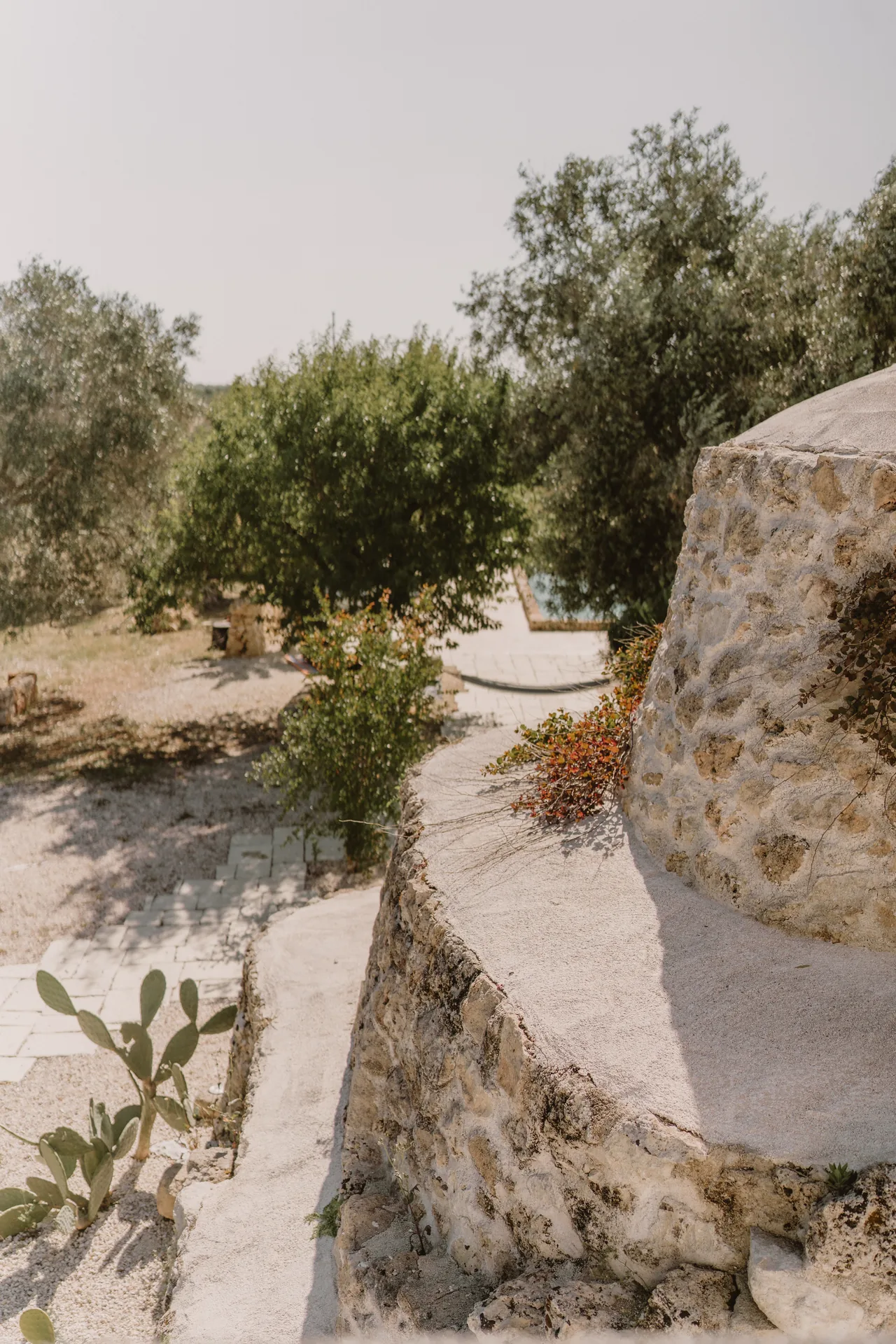
Ostuni and Locorotondo are whitewashed with lime, and the idea that the lime kept out the plague is more story than history. The fortified masserie around here have their own page. And in the gravine, from Massafra to Matera, architecture works in reverse: churches and houses dug out of the rock.
Foggia, the tratturi and transhumance
“Settembre, andiamo. È tempo di migrare.” (“September, let us go. It is time to migrate.”) D’Annunzio wrote it for the shepherds of Abruzzo, but the road ended here, in the Puglias. For centuries, every autumn, the flocks came down from the mountains around L’Aquila, Celano and Pescasseroli to spend the winter on the Tavoliere of Foggia. In spring they went back up.
It was nothing new even for the Romans. Varro, in the first century BC, kept his sheep in the mountains of Rieti in summer and in Apulia in winter. At Sepino, in Molise, the gate of the Roman town still bears an order from the emperor’s prefects to the local magistrates: stop harassing the flock contractors, the treasury is losing out. Even then, the taxman stood up for his sheep.
The roads of the flocks were called tratturi, and they were not roads: they were corridors of grass sixty Neapolitan paces wide, about a hundred and eleven metres – a pasture on the move. The longest, the Regio Tratturo L’Aquila–Foggia, the Tratturo Magno, is about 244 kilometres long; around it ran the other royal tratturi towards Foggia, Candela and Lucera, and a network of tratturelli and branches.
In 1447 Alfonso of Aragon turned them into a tax machine: the Regia Dogana della mena delle pecore di Puglia, the royal customs house for the droving of sheep. At first it was in Lucera; in 1468 it moved to Foggia, where all the tratturi met and where the fair was held in May. The flocks were obliged to come down, and from 29 September to 8 May the grass of the Tavoliere was theirs. In return they paid the fida, a tax on every head, and had guaranteed pasture, cheap salt, a court all of their own and the Dogana’s bread: a gift at first, until that too became a tax.
From 1553 the flocks were no longer counted: the shepherd declared, in secret, how many sheep he had, and was given grass to match. In 1598 the declared sheep came to three and a half million; the pastures, according to those who have studied the records, could hold one million one hundred thousand at most. The rest were sheep on paper.
For almost four centuries the Tavoliere stayed pasture by law, and the plough was an enemy of the treasury. That is why the province of Foggia is so different from the Bari area and Salento: few towns, large masserie, an open plain, and a city that grew up as the capital of wool. In 1806 the French abolished the Dogana; in 1865 a law of the Kingdom of Italy allowed the land to be bought outright, and the Tavoliere went over to wheat.
In Foggia the Palazzo Dogana still stands, on Corso Garibaldi, now home to the provincial government, and the State Archives hold the sheep records, going back to 1536: one of the great archives of European pastoralism. Grassy stretches of the Tratturo Magno can still be walked or cycled, at Sepino there is the Roman gate, and many towns have a Via del Tratturo. The tratturi are protected by the state, and since 2019 transhumance has been on UNESCO’s list of Intangible Cultural Heritage.
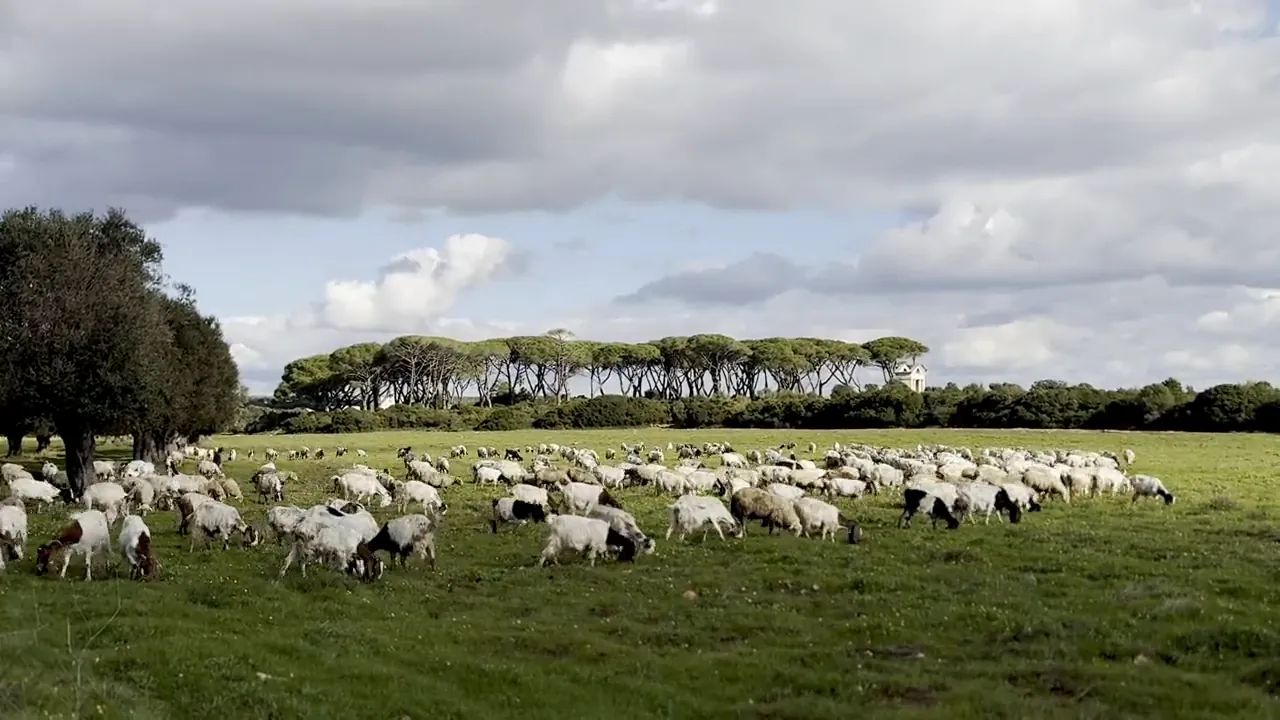
The sheep that graze under the pines near the house in winter do not come from Abruzzo. But the shepherd who takes them to the grass does the same job.
Is Matera in Puglia? Across the border, in Basilicata
Matera is in Basilicata, but its stone is from Puglia. The “tufo” of the Sassi is the same rock as in the gravine of Laterza, Castellaneta and Massafra, and geologists have named it after a town in Puglia: Gravina calcarenite. Until 1663 Matera was in Terra d’Otranto, like Maruggio, and then it was the capital of Basilicata until, in 1806, the French chose Potenza instead. Matera’s dialect, too, looks more towards Bari than towards Potenza.
In the 1950s the Sassi were the “national disgrace”, and a law of 1952 ordered them to be emptied; in the 1980s people began to move back, and in 2019 Matera was European Capital of Culture, together with Plovdiv, after beating, among others, Lecce.
The border, after all, has been uncertain for two thousand years: Horace, born in Venosa, wrote that he did not know whether he was Lucanian or Apulian. Potenza is another story again. In some of the towns around it – Picerno, Tito, Pignola – they speak northern-type dialects, brought in the Middle Ages by settlers from the north. And on 29 May, for the feast of San Gerardo, the city holds a parade of the Turks the saint is said to have driven off: no document records the siege, and the parade is magnificent all the same.
From Corni di Fiasco, Matera is an hour and three quarters away; the other driving times are on the map of things to do near Maruggio.
Saints, bonfires and older gods: the feasts of Puglia
In the Puglias the saints arrived late, and often moved in where someone else already lived. In Bari, Saint Nicholas, a Greek bishop from Asia Minor, is venerated by Catholics and Orthodox together: the Orthodox liturgy is also celebrated in the crypt, and the city’s Russian church was designed by the architect of Lenin’s mausoleum. According to the basilica, the “manna” gathered from the tomb every 9 May was analysed by the University of Bari in 1925 and found to be very pure water: half a litre a year. In Salento, for centuries, you could go to Mass in Greek or in Latin, and in some villages the parish priest had a wife until the eighteenth century.
On the Gargano the Archangel Michael lives in a cave that, according to tradition, no bishop has ever consecrated, and the Lombards made it their sanctuary. At Leuca the basilica is called de finibus terrae, at the end of the earth, and stands where, an inscription says, sacrifices were once made to Minerva. It is said that whoever does not go there alive will go there dead.
And then the winter fires. At Novoli, on 16 January, for St Anthony the Abbot, they burn a pyre of vine prunings as tall as a building; at San Marzano, on the eve of St Joseph’s Day, the olive faggots for the bonfire arrive on horseback, in procession. At Matera, on 2 July, a year’s work goes into a cart for the Madonna della Bruna, and the crowd tears it to pieces in a few minutes. The pizzica, the tarantate and the fires of our own village are in the Stories of Maruggio. These are the feasts for anyone who comes to Puglia in winter.
The food of Puglia: different every ten kilometres
The same fritter of leavened dough is called pittule in Lecce, popizze in Bari, pèttëlë in Taranto. In San Severo it is scorpelle; in Torremaggiore, ten kilometres away, sfringioli. And the day they are fried changes too: St Martin’s Day around Lecce, St Cecilia’s in Taranto, the eve of the Immaculate Conception in the Valle d’Itria.
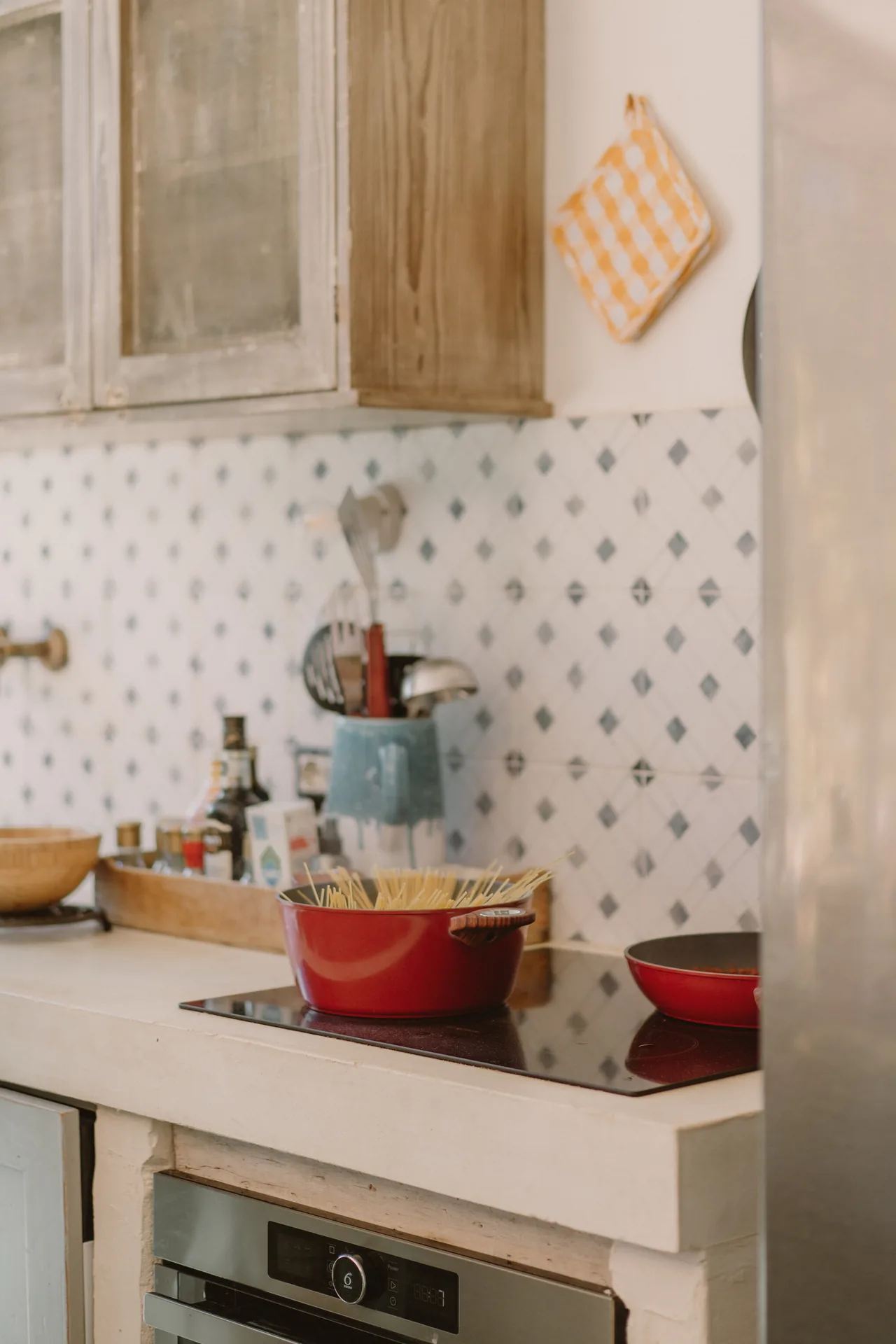
Orecchiette belong to the whole region, and every town has its own name for them. The braciole, the meat rolls of the Sunday ragù, were originally horse: the working animal, at the end of its career, ended up in the sauce. In Mola di Bari the calzone is not fried: it is an onion pie, for Good Friday. In Locorotondo you choose your meat at the butcher’s and he cooks it in his own oven, on spits standing upright beside the embers; in Martina the capocollo is marinated in vincotto and smoked with the bark of the fragno, an oak of the Murgia.
At the table, too, the legends are older than the dishes. Burrata, which seems as old as the olive trees, is from the twentieth century: one of the first written mentions dates from 1931. And Horace, whom everyone quotes on the bread of Altamura, was in fact complaining about the bread of Canosa, full of grit. Altamura bread has its PDO all the same, and Matera’s, twenty kilometres away and in another region, its PGI.
Across the border there are peperoni cruschi, sun-dried peppers fried for a few seconds, and lucanica, a sausage the Romans were already fond of. Primitivo di Manduria and the wineries where you can taste it have their own page; tria is in the Stories.
In the evening, after a day in the Puglias, you come home to Salento, among the olive trees of Corni di Fiasco, one minute by car from the sea at Campomarino di Maruggio. The Puglias are best explored out of season: in spring and autumn, or in winter.
Frequently asked questions
Why did Italians call Puglia “le Puglie”, in the plural?
Because for centuries Puglia was made up of three historic provinces: Capitanata (Foggia and the Gargano), Terra di Bari, and Terra d’Otranto (the whole south, from Taranto to Leuca). That is the most likely explanation, though no document proves it. The plural was the normal form in laws and newspapers, from the Corriere delle Puglie of 1887 to the 1898 law on the Acquedotto Pugliese. The singular took over with the Republic.
What is the difference between Salento and the Valle d’Itria?
They are two different areas of Puglia, and the Valle d’Itria is not part of Salento. The Valle d’Itria is a karst basin on the Murgia, between Martina Franca, Locorotondo, Cisternino and Alberobello: trulli with cones and pinnacles, white towns, dialects of the Bari type. Salento is the peninsula south of Taranto and Brindisi: Lecce stone and the Baroque, pajare shaped like truncated cones, Salentino dialect and Griko. From Corni di Fiasco, in Maruggio, the Valle d’Itria and Lecce are both an hour away by car.
How many dialects are spoken in Puglia?
Two large families, plus three minority languages. In the north and centre people speak the Apulian dialects, related to Neapolitan and Abruzzese; in Salento, the Salentino dialects, close to Sicilian and Calabrian. Between the two lies a band of transitional dialects, running roughly from Taranto to Brindisi. The minority languages, protected by law, are Griko, Arbëresh and Franco-Provençal.
Where are Griko and Albanian spoken in Puglia?
Griko, a form of Greek with a thousand years of its own history, is spoken in the Grecìa Salentina, between Lecce and Otranto: in Calimera, Castrignano de’ Greci, Corigliano d’Otranto, Martano, Martignano, Sternatia and Zollino, and it only just survives in Melpignano and Soleto. Albanian, or Arbëresh, is spoken in San Marzano di San Giuseppe, in the province of Taranto, and in Chieuti and Casalvecchio di Puglia, in the province of Foggia. In all these villages they are spoken mostly by the elderly.
What were the tratturi, the transhumance routes to Foggia?
The tratturi were the grass roads of transhumance, about 111 metres wide, along which for centuries the flocks of Abruzzo and Molise came down to winter on the Tavoliere of Foggia. The longest, the Regio Tratturo L’Aquila–Foggia, known as the Tratturo Magno, is about 244 kilometres long. Grassy stretches can still be walked or cycled, and in Foggia the Palazzo Dogana still stands. Since 2019 transhumance has been on UNESCO’s list of Intangible Cultural Heritage.
Is Matera in Puglia?
No, Matera is in Basilicata, and is a provincial capital. Until 1663, though, it was part of Terra d’Otranto, and so of the Puglias, and it stands on the same Murgia as Altamura and Gravina: the stone of the Sassi is the same as that of the gravine of Puglia, and the dialect looks more towards Bari than towards Potenza. From Corni di Fiasco, in Maruggio, Matera is about an hour and three quarters by car.
Is food the same all over Puglia?
No, food in Puglia changes from one area to the next, sometimes from one town to its neighbour. The same fritter of leavened dough is called pittule in Lecce, popizze in Bari and pèttëlë in Taranto, and is fried on different days: St Martin’s Day around Lecce, St Cecilia’s in Taranto, the eve of the Immaculate Conception in the Valle d’Itria. Orecchiette belong to the whole region, but go by different names; smoked capocollo comes from Martina Franca.
The Puglias all around, the house at the centre.