
Corni di Fiasco · A trullo by the sea
A trullo by the sea
A trullo by the sea, in Puglia, is rarer than you might think: almost all the trulli to rent are in the Valle d’Itria, in the hills, and from up there the sea is a day out. Corni di Fiasco is a Saracen trullo on the Ionian coast, one minute by car from the beach at Campomarino di Maruggio.
Anyone looking for a trullo in Puglia nearly always ends up in the same place: the Valle d’Itria, between Alberobello, Locorotondo, Cisternino and Martina Franca. That is where the white cones of the postcards are, and that is where almost all the rentals are. From up there you reach the sea by car: from Alberobello, the coast at Monopoli is about twenty kilometres away.
Corni di Fiasco is on the other side, further down, on the Ionian coast of Salento. The trullo stands among the olive trees, and the beach is one minute away by car.
Trulli in the hills, trulli by the sea
The Valle d’Itria is a karst plateau, the Murgia of the trulli: white towns on the hills, around four hundred metres above sea level (Alberobello 428, Locorotondo 410, Martina Franca 431), woods of fragno oak, vineyards of white grapes, dry-stone walls running up and down. There are trulli by the thousand, and those of Alberobello have been a UNESCO World Heritage Site since 1996. In summer the evenings are cool; in winter it is colder up there than on the coast.
Down here the landscape is different. The countryside is flat, the olive trees are bigger and older, and the horizon ends at the sea. There are trulli here too, but they are few, lower and wider, and nobody comes looking for them.
Valle d’Itria or the Ionian coast?
Where to stay in Puglia, then? It is not a contest. If you want the white towns, the masserie in the hills, dinners in Cisternino and cool August evenings, the Valle d’Itria is the right place. If the sea, for you, is not a day out but the rhythm of your day, and you want to see the trulli without sleeping among the coach parties, stay down here.
From Corni di Fiasco to the Valle d’Itria it is an hour by car. You go up for the day, have dinner in Cisternino or Martina Franca, and come back in the evening to sleep near the sea. Lecce is an hour away too, Matera an hour and three quarters: everything, with driving times, is on the map of the area.
And if you come out of season, the difference shows even more. In winter the Ionian coast is milder than the hills, the beaches are empty and you walk along the shore in a jumper. That is why from November to March we open the house for long stays, and in spring and autumn the sea is still, or already, there to swim in.
The Saracen trullo
Our trullo does not have the slender profile, the neatly shaped cone and the pinnacle on top that the photographs have taught you to expect. It is a trullo saraceno, a Saracen trullo: a single cone, low, made of the limestone of this countryside, a stone that is easy to work and that breathes.
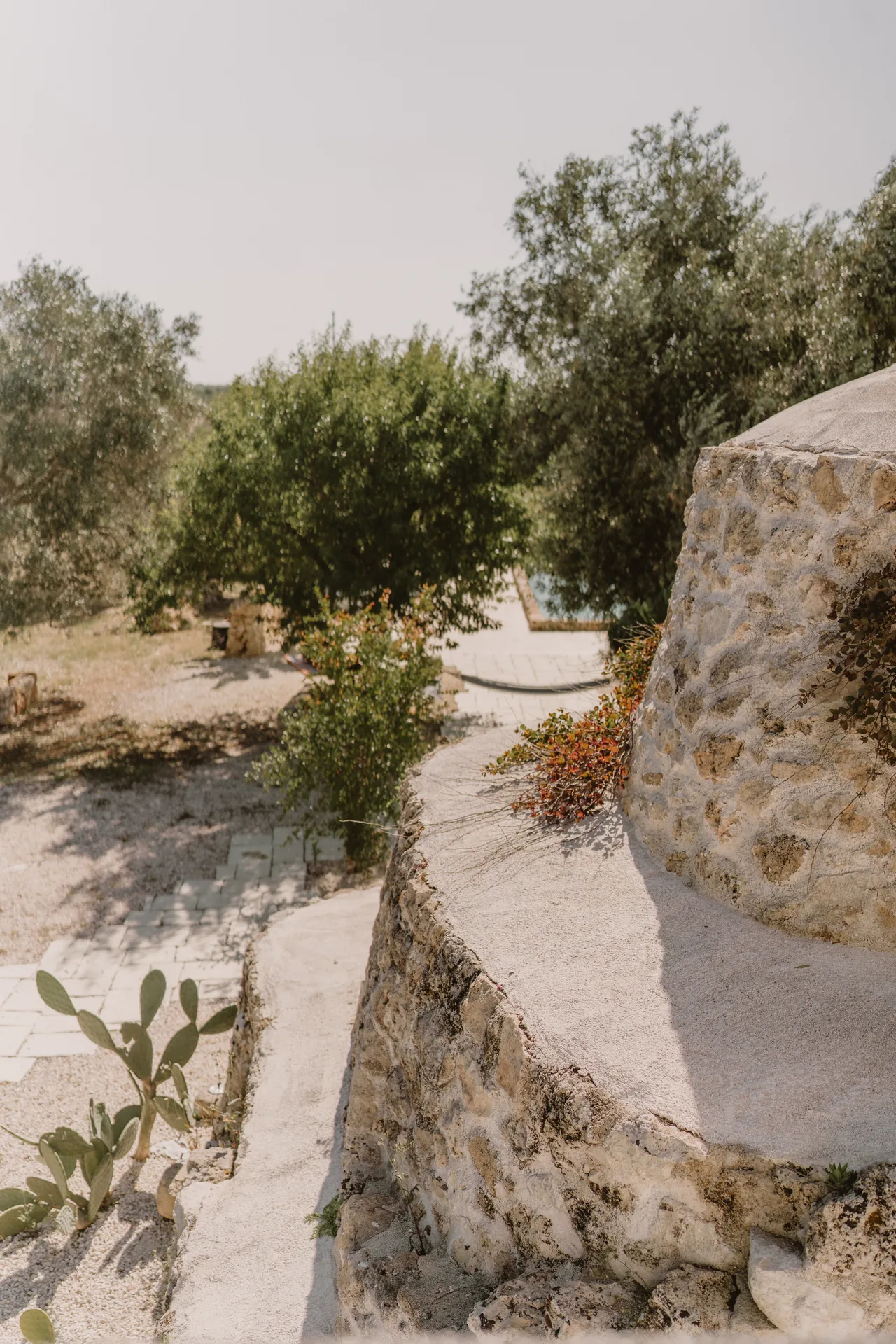
Like all trulli it is built dry, without mortar: stones laid in ever-tighter rings until they close in a corbelled dome that holds itself up. Those who have studied this countryside point to the strip near the sea south-east of Taranto, between Lizzano, Torricella and Maruggio, as the area where trulli of this kind are thickest on the ground. They served as shelters from storms, and in summer, at harvest time, sometimes two families at a time slept in one.
Why they are called Saracen, nobody knows. Some point to a resemblance to Arab buildings, others to the memory of the pirates who landed on this coast. They remain guesses. What is certain is that you must never call it a trullo in front of anyone from the Valle d’Itria: for them, the only trulli are theirs. And we let them believe it, with a smile.
The real Saracens, the ones who came from the sea, are in the Stories of Maruggio and beyond.
What changes in your day
Put simply: from a trullo in the hills the sea is a day out; from here it is a break.
In the morning you go to the beach before breakfast, when the sand is still cool and at Campomarino there are only the fishermen and someone with a dog. You come back, have breakfast under the pergola, read by the pool.
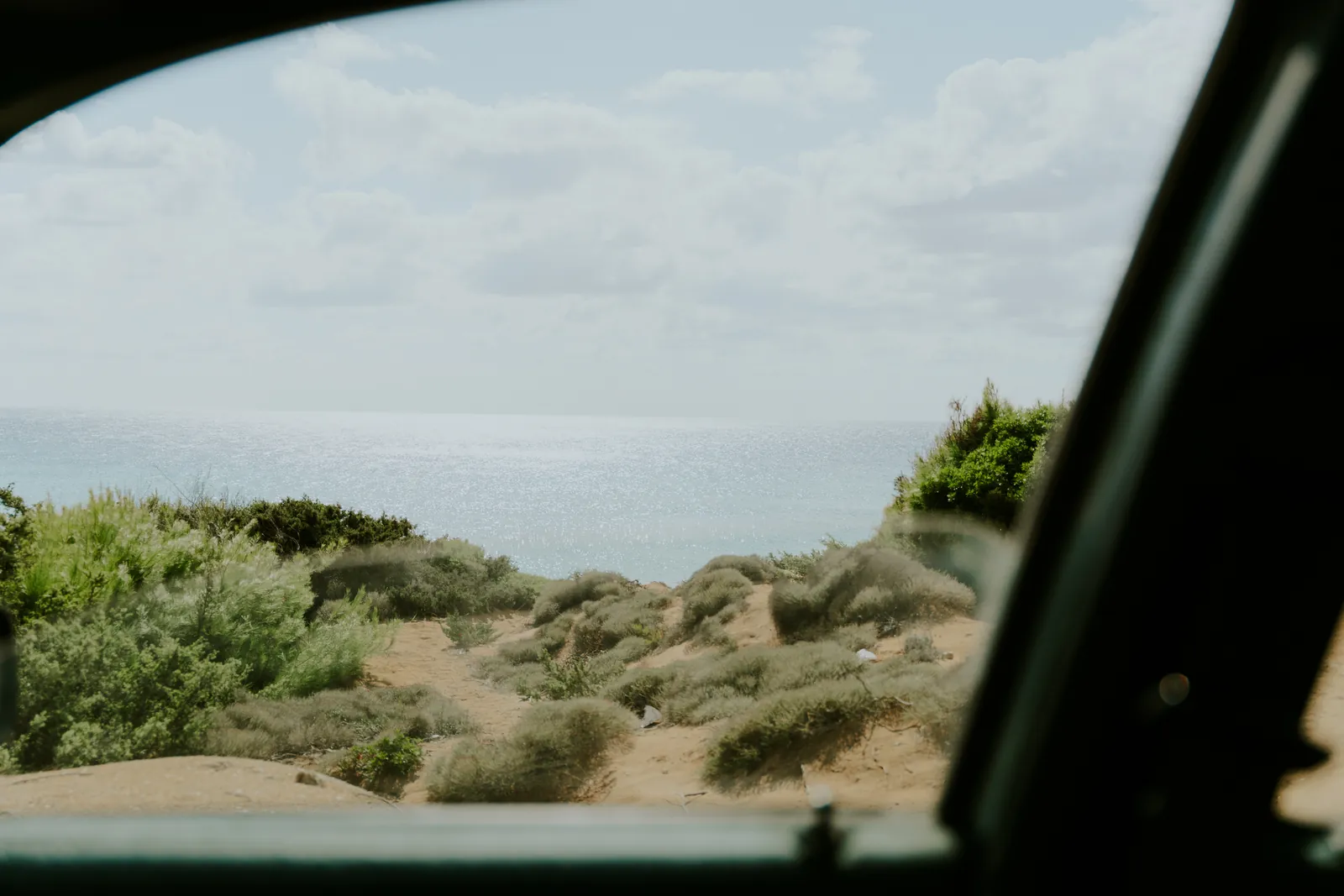
In the afternoon the sea changes its face. With the tramontana it is a clear, flat sheet; with the scirocco come the waves and the surfers. Here the first question of the morning is not whether it will rain: it is which way the wind is blowing, and you choose your beach accordingly. More in the chapter “Scirocco or tramontana?”.
In the evening the sun goes down into the Ionian. On the Adriatic coast, at Polignano and Monopoli, the sun rises out of the sea; on this side it sets into it, and in winter, at Torre Ovo, you see it sink right into the water.
And then there are the small things: the salt that stays on your skin all the way home, the outdoor shower after the beach, the fish bought at the little harbour of Torre Colimena and cooked in the evening.
The house, in a few lines
Corni di Fiasco is a single-cone trullo restored between 2019 and 2024, with a stone house beside it: two bedrooms, one beneath the cone of the trullo, and one bathroom, for four guests plus one on a folding bed. Two hectares of private land with centuries-old olive trees, figs and almonds, and nothing shared. A private pool twelve metres by three and a half, 1.40 metres deep, designed with the old watering troughs of the masserie in mind. Air conditioning in every room, Wi-Fi, two covered verandas and a rooftop terrace looking out over the olive groves.
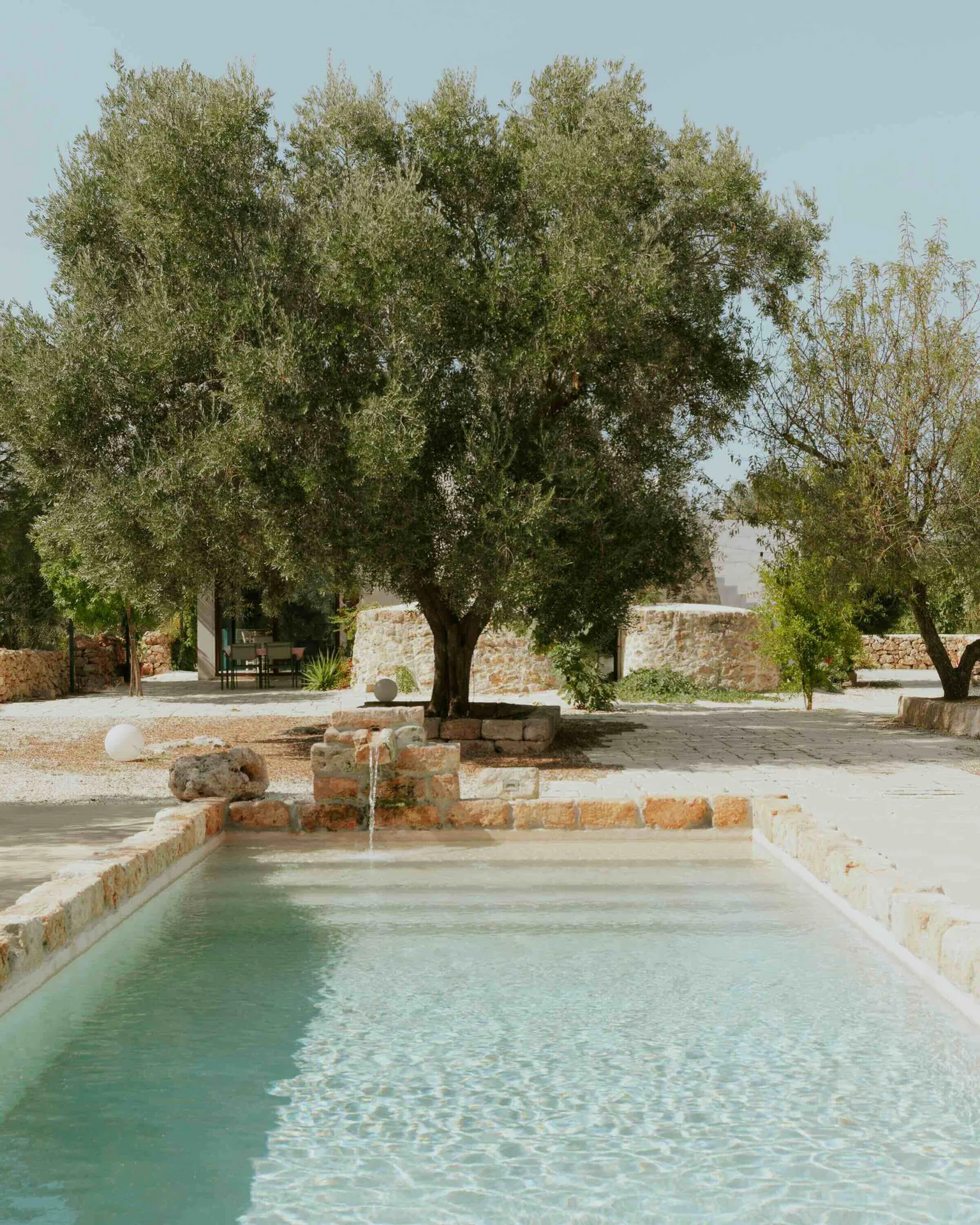
The sea can be seen in the distance, beyond the olive trees, and it is one minute away by car. And when you cannot see it, you can hear it: with the scirocco and a heavy sea, its rumble reaches the house loud and clear, like a distant storm that never ends. The rest, with photographs, is on the house page.
Beaches a few minutes away
The beaches are the reason this trullo is where it is.
Campomarino, one minute by car: the nearest beach, with the Parco Dune di Campomarino, 41 hectares of dunes and Mediterranean scrub to cross on the boardwalks, and the Spiaggia d’Ayala, a wild beach with no facilities and no noise.
Salina dei Monaci and Torre Colimena, ten minutes: the old saltpan where you watch the flamingos, and the beach in front of the tower.
San Pietro in Bevagna, fifteen minutes: a river, the Chidro, that reaches the sea with its water at eighteen to twenty degrees all year round.
Punta Prosciutto, twenty minutes: white sand, and shallow turquoise water for tens of metres. In summer, arrive early.
Porto Selvaggio, forty-five minutes: pine woods, rocky coves, and a path down to the sea.
Everything, with times and things to know, is on the page about beaches near Maruggio.
Frequently asked questions
How far is Corni di Fiasco from the sea?
One minute by car: it is the beach at Campomarino di Maruggio. Punta Prosciutto is twenty minutes away.
Can you see the sea from the trullo at Corni di Fiasco?
Yes, in the distance, beyond the olive trees. When the scirocco blows, you can hear it too.
Is the pool at Corni di Fiasco private?
Yes, it is for the guests’ exclusive use, like the two hectares around it. Nothing is shared.
How far is the Valle d’Itria from Corni di Fiasco?
About an hour: Alberobello, Locorotondo, Cisternino and Martina Franca can be done in a day.
How many guests does Corni di Fiasco sleep?
Four, in two bedrooms, plus a fifth guest on a folding bed.
What is the minimum stay at Corni di Fiasco?
5 nights, 7 from May to September. The maximum is 28 nights.
The trullo among the olive trees, the sea one minute away.