Corni di Fiasco · Winter
A winter retreat in Puglia
From November to March Salento slows down. The light is low and clear, the beaches are empty, the olives are pressed. This is the season we keep for people who want to stay a long while, or even winter here: from 5 nights; 14 nights for €1,554, 28 nights for €2,604. And the Wi-Fi is good enough for remote work.
The quiet season
Winter in Salento
Days are mild enough to walk the coast in a jumper, bright enough to eat outside at noon. The groves are being harvested, the villages belong to the people who live in them. You hear the wind in the olive trees, and little else.
Mild doesn’t mean warm. From December to February it’s around 13 °C at midday, and at night it drops to between 5 and 7 °C. It rains on six or seven days a month, on average; but there are winters when it rains for days on end. Here it’s the wind that decides the weather: with the scirocco the air turns mild and damp, with the tramontana the sky is swept clean and it gets properly cold. They call that wind scorcia crapi, and you’ll find out why in “Scirocco or tramontana?”.
Winter packages 2026-27 · until 14 March
Stay longer, each night costs less
Booking direct only. Excluding 20 December – 6 January. All included, tourist tax extra. Stays of 5 to 28 nights.
- Pay 20% to book; the balance is due 30 days before arrival.
- Free cancellation up to 60 days before arrival; a refund of 50% of the amount paid up to 31 days before.
- Secure payment through our booking system. €500 security deposit: a hold on your card, not a charge.
Here the seasons run the other way
November – March
Winter is green
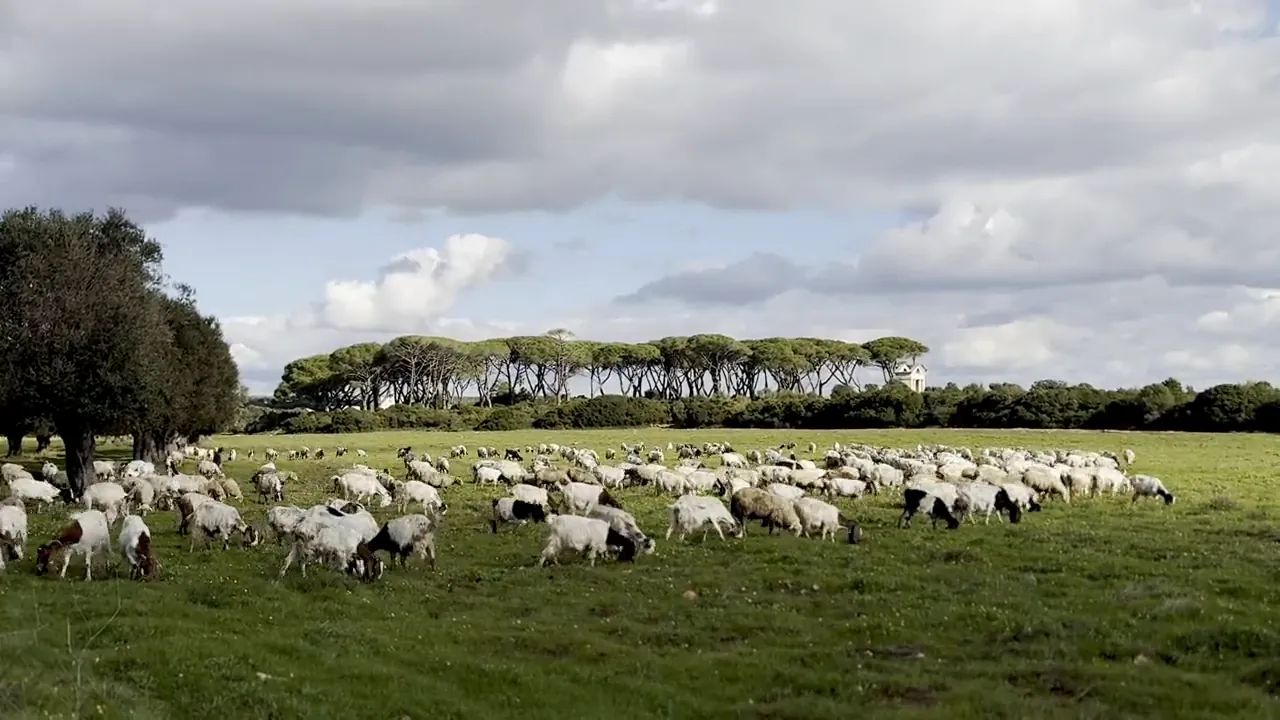
If you come from the north, green means summer. Here it’s the other way round: the first rains turn the fields green again, the olive trees shine and the flocks are back on the grass.
Before November come spring and autumn, with the sea still there to swim in.
The climate
Puglia weather and sea temperature in winter, month by month
| Month | Average high (air) | Average low (air) | Rainy days a month | Sea temperature |
|---|---|---|---|---|
| November | about 17 °C | about 10 °C | 6–7 | about 18 °C |
| December | about 14 °C | about 7 °C | 7–8 | about 15 °C |
| January | about 13 °C | about 5 °C | about 7 | about 14 °C |
| February | about 13 °C | about 5 °C | about 6 | about 14 °C |
| March | about 15 °C | about 7 °C | about 6 | about 14 °C |
These are averages for the Taranto area, on the Ionian coast, rounded. Air temperatures are taken at the Taranto-Grottaglie weather station, a little way inland: on the coast the nights are a touch milder. Sea temperatures are the Taranto average. And averages are averages: a winter can be wetter or colder than this.
The evening
Winter evenings, by the fire
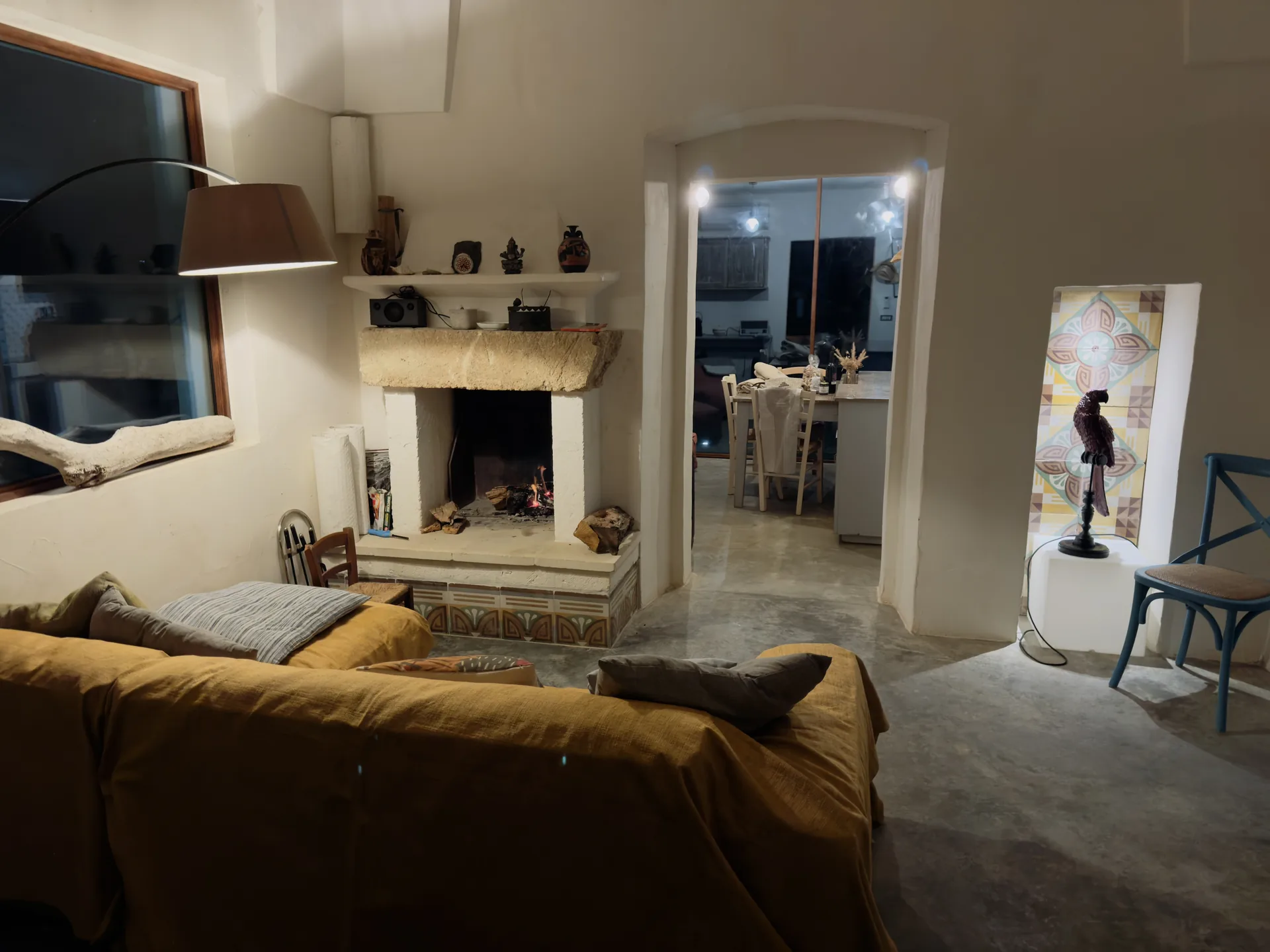
In winter the day ends early, and it ends indoors. Around five it’s time to light the fire and open a bottle of good wine, while outside it gets dark. If the scirocco is blowing, you might just hear the sea grumbling beyond the olive trees.
Good wine, here, means Primitivo, and it’s made twenty minutes away, in Manduria. In winter the wineries have time for you: book ahead, and you can taste it at your own pace. Where to go is on our page about the Primitivo wineries of Manduria.
The morning
Winter mornings, frost on the grass
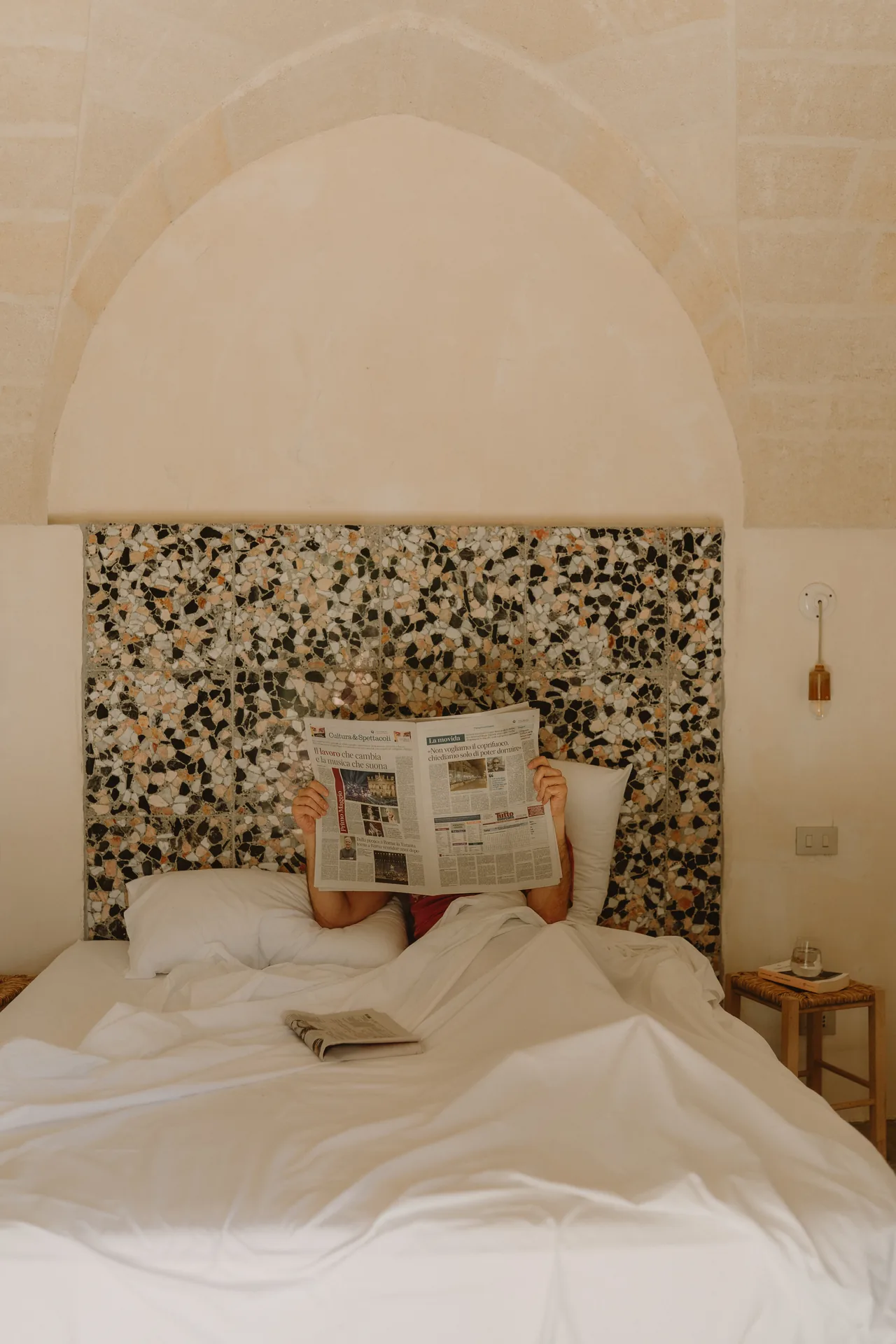
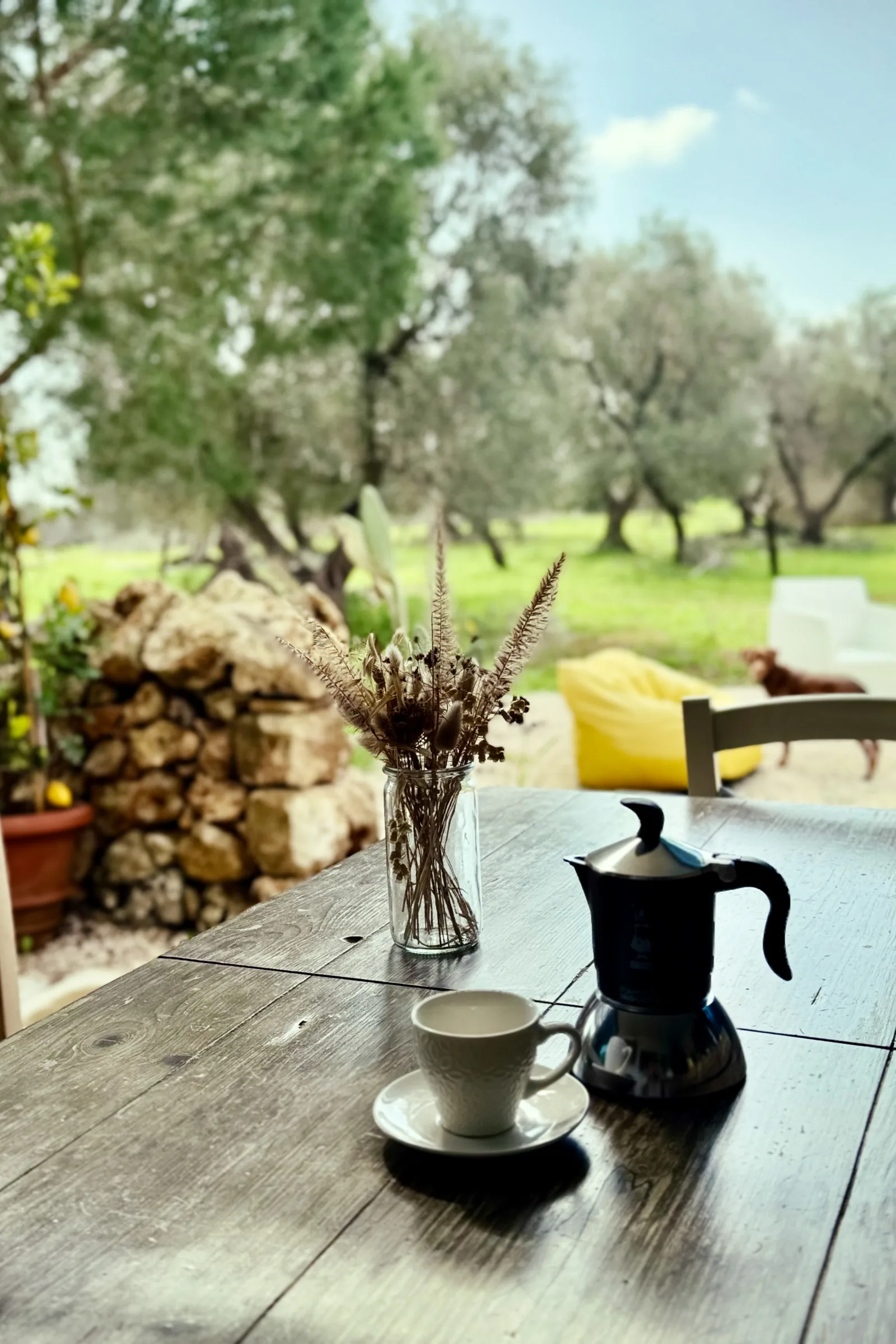
In the morning you wake to the grass white with frost and the birds whistling for all they’re worth. You stay under the covers a little longer, listening to them. In November, first thing, the voices of the olive harvest drift in from the fields round about, with the rattle of the rakes combing the branches. Then the sun comes out, the frost goes, and the grass is left green and wet. On good days the moka goes outside, onto the table in front of the olive grove.
The days
Winter sun, and rainy days
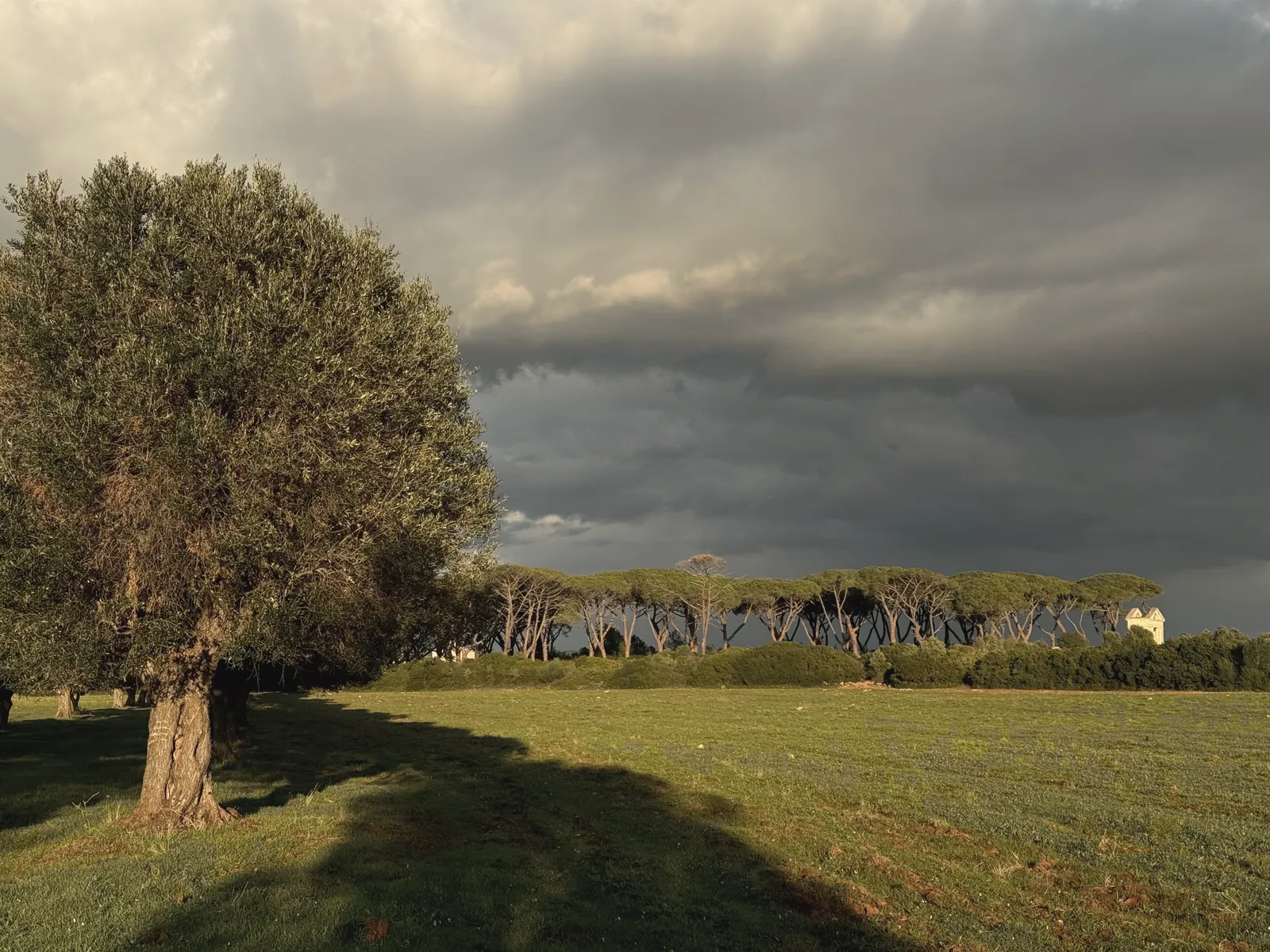
There are more good days than you might think. The winter sun is gentle, and by midday it has your jumper off. By half past four it’s already time to go down to the beach and watch it set: on this side of Puglia the sun doesn’t come up out of the sea, it goes down right into it, towards Torre Ovo.
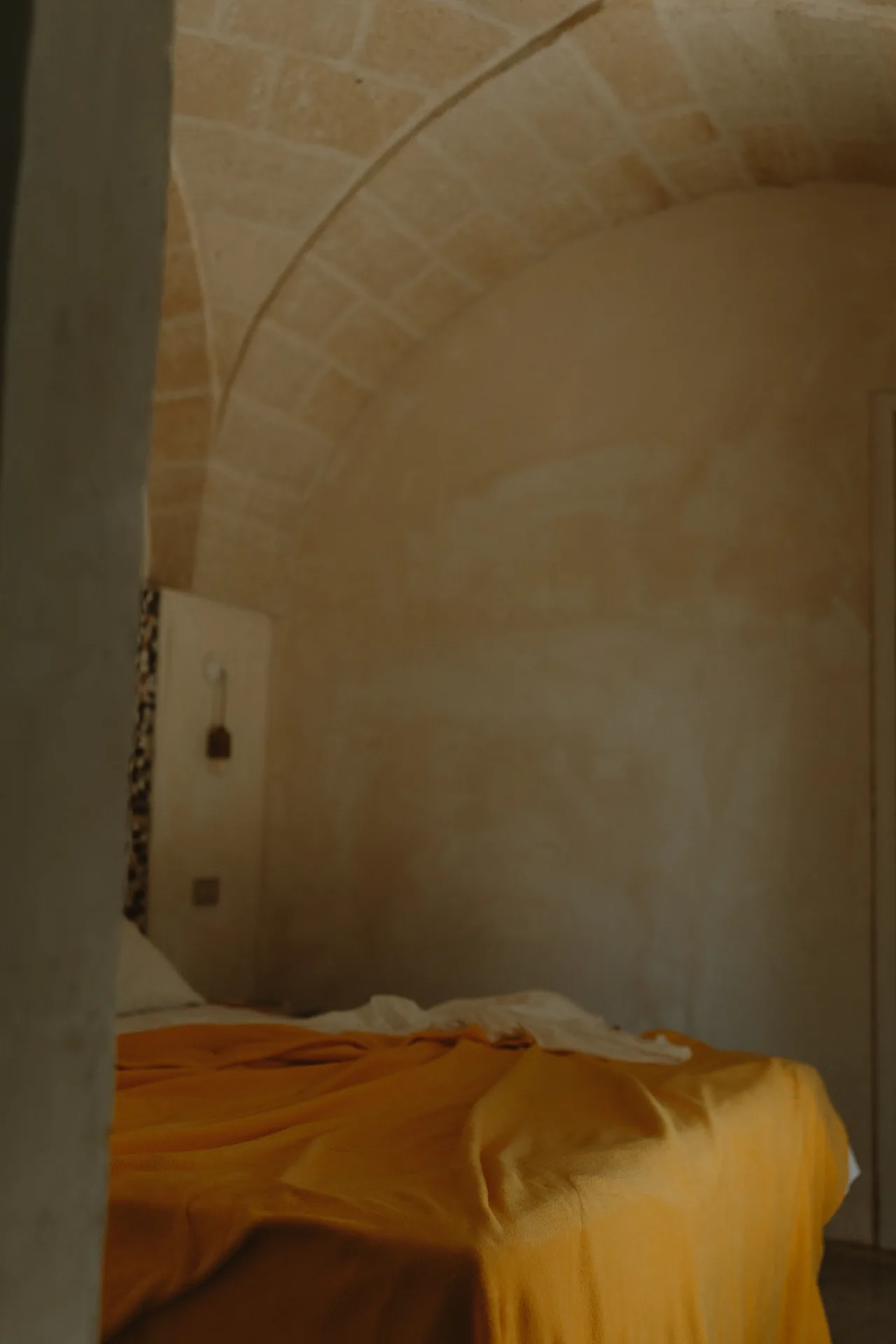
And then there are the rainy days, because winter has them. You read under the stone vaults, cook something that takes its time, work at the kitchen table with the wet olive grove in front of you. If it rains for days, the house feels it.
The house
A heated trullo, best for two in winter
The house is heated, and there is a fireplace. One honest note: a trullo breathes — there is no insulation — so after long spells of rain it can feel damp. In winter we recommend it for two people. Getting here is part of the plan too: flights that run only in winter, the drive, the dog’s papers, on the page How to get to Puglia.
Working from here
Long mornings, good Wi-Fi
The internet is good enough to work from the house: calls, files, a full day at the kitchen table with the moka on. Then the afternoon is yours. More in Working from here.
“Such a chill and beautiful place. There is everything you need for a long stay. Highly recommend!”In the village, no hurry
Food shopping in winter
You do your shopping in the village, five minutes away. The supermarket has the everyday things; vegetables come from the greengrocer, who brings them in from the local fields; mozzarella, burrata and ricotta from the dairy, early in the morning. For fish there’s the fishmonger by the little harbour at Torre Colimena, ten minutes away. And from November there’s the new oil, green, sometimes cloudy, that catches in your throat.
On the coast, in winter, many places close. The ones that stay open all year round, and are worth a dinner out, are marked on the map of the area and in the guide we send you before you arrive.
The kitchen
Cooking in winter, slowly
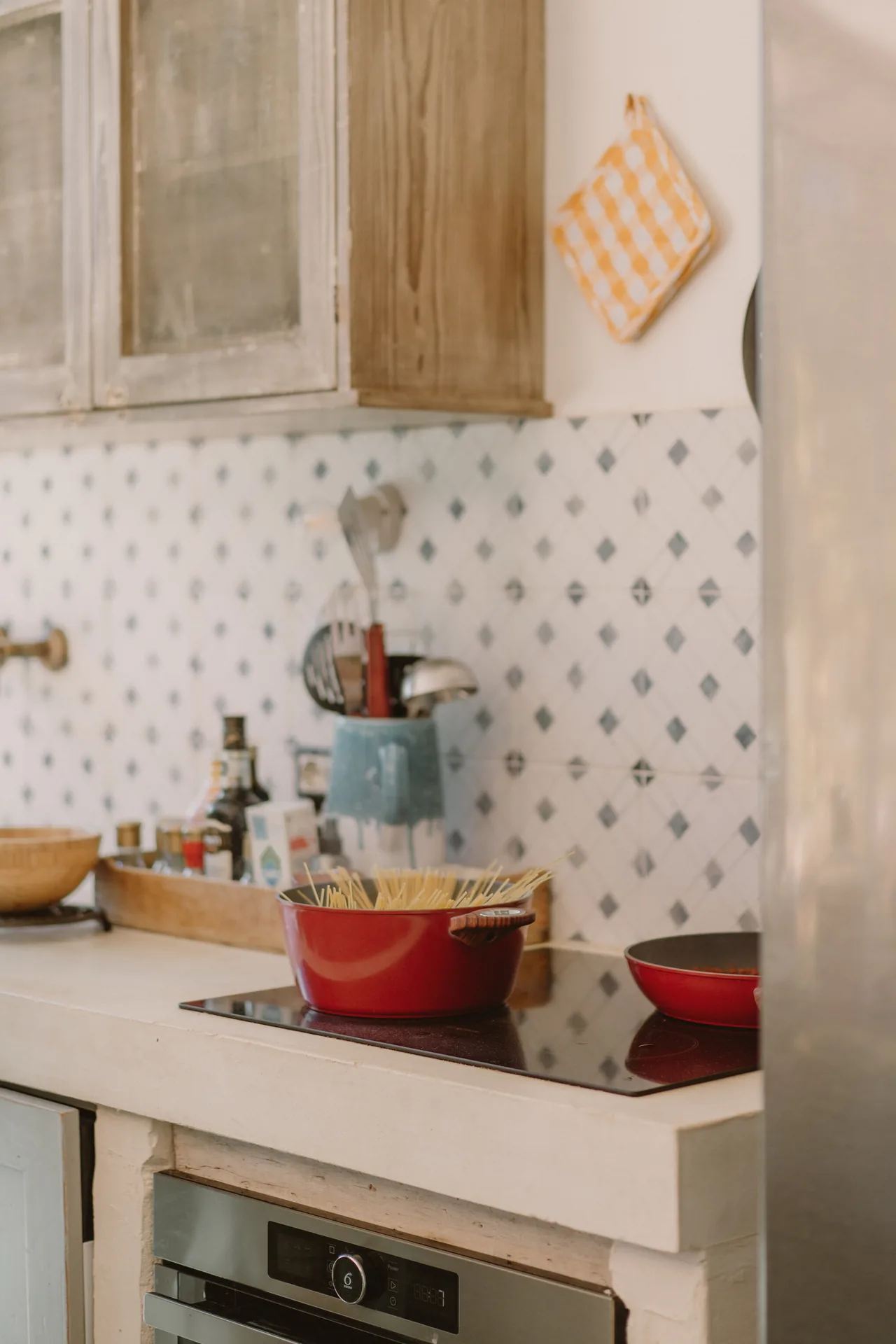
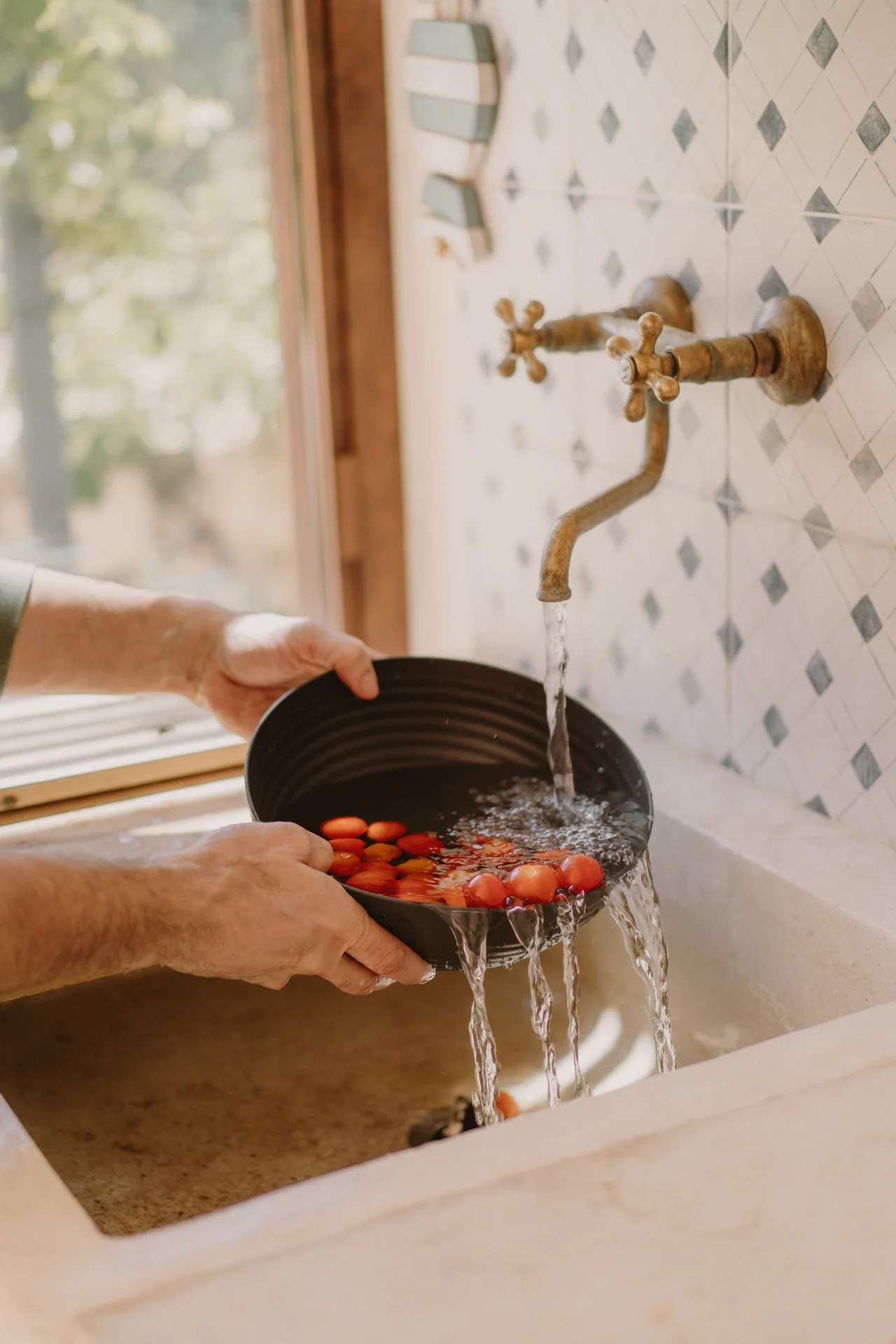
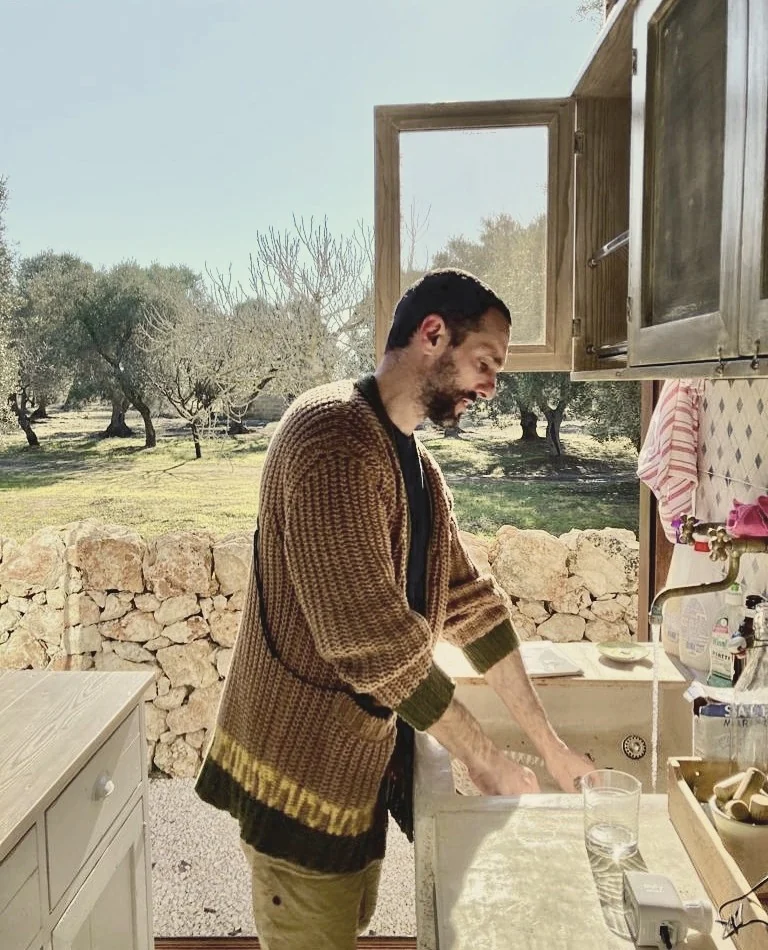
Winter is the season of the olive harvest, of artichokes and citrus, of new oil on bread. The kitchen opens onto the grove and the tap still runs over the old stone sink.
It’s also the season of things that cook slowly: pulses, greens from the fields, and dried broad beans cooked down to a purée with chicory, which everyone in Puglia knows how to make and every village calls by its own name: fae e foje, favi e fogghi, ’ncapriata. And you taste the freshly pressed oil the simplest way there is: a slice of toasted bread, a drizzle of oil, a pinch of salt.
The feasts
Winter festivals in Puglia, from November to March
In winter, round here, it’s the saints who keep the calendar. And more than one saint has something to fry.
November: St Martin, the new wine and St Cecilia
It starts on 11 November, St Martin’s Day, when Salento opens the new wine. “A San Martino ogni mosto diventa vino”: by St Martin’s, every must has turned to wine. Around the glass go roast chestnuts, grilled meat and, in the villages near Lecce, pittule: there, these are the first of the year. Ten days later, on the 21st, Maruggio has its most heartfelt feast, the Madonna del Verde, with the ssittàta alla Matònna on the eve: more about it in our Stories of Maruggio.
In Taranto, half an hour from here, Christmas starts on 22 November, a month ahead of everywhere else: they call it the longest Christmas in Italy, and starting in November, it’s hard to say they’re wrong. It’s St Cecilia’s Day. At about three in the morning the bands come out and go round the city until daybreak, and in the cathedral of San Cataldo, still in half-darkness, they play the pastorali, the Christmas pastoral tunes. Meanwhile, at home, people fry pettole, and the first ones go to the musicians. Before the bands, the people of Taranto say, it was the zampognari, bagpipers who came down from Abruzzo and Molise in the nineteenth century; and pettole were supposedly the fault of a housewife so taken with their music that she let the dough rise too far, and threw it into the boiling oil.
December: the Immaculate Conception, St Lucy, the Madonna della Madia and Christmas in Puglia
In Salento pettole are called pittule, and for many the right day to fry them is 7 December, the eve of the Immaculate Conception. It’s a fast day, or nearly: at midday all you eat is puccia, the white bread of the eve, with a meatless filling of tuna, capers and anchovies, and there are queues outside the bakeries. In the evening the fast ends in the frying pan: “te la Mmaculata, la prima pittulata”, for the Immaculate, the first batch of pittule. Plain, with cauliflower, with salt cod, or sweet, with honey and vincotto. Which are the first of the year — these, St Martin’s or St Cecilia’s — depends on who you ask, and nobody gives an inch.
For St Lucy’s Day, in Lecce, there was a fair of nativity figurines, and there still is: they call it the Fiera dei pupi, because pupi, here, are the figurines, in papier-mâché and terracotta, and for much of December it fills the cloister of the Teatini. In Lecce they trace it back to the sixteenth century, even though no document saying so has turned up yet. “Santa Lucia, il giorno più corto che ci sia”, goes the proverb: St Lucy’s, the shortest day there is. And it was right, until 1582, when the calendar changed.
Three days later, at dawn, in Monopoli people watch the sea: they’re waiting for the Madonna. The story has it that her icon arrived on a raft, on the night of 16 December 1117, and that the raft’s beams went into the roof of the cathedral. Every year, at Cala Batteria, there’s the vigil with the bishop, the fireworks, the divers lighting the water red; then the icon goes in procession to the cathedral, and if the sea is rough the scene on the water is called off. In summer the raft comes in again, on the evening of 14 August. From here it’s an hour and twenty minutes’ drive, with the alarm set for the dead of night: this feast has no dish, it has the cold of dawn.
Then comes Christmas, and the pupi from the fair find their place: the nativity scene, here, is serious business. Grottaglie, the potters’ town twenty-five minutes from here, fills the Castello Episcopio with ceramic nativity scenes from December into January. In recent years San Marzano, closer still, has taken its living nativity down into the gravina, the ravine, of the sanctuary of the Madonna delle Grazie, with about three hundred people in costume. And on Christmas Eve, in Maruggio, they light li fuechi di cristo piccinnu, the fires of the Baby Jesus, which you’ll find in the Stories, under “The pagan”.
On Christmas Eve almost all of Puglia eats fish, and Salento eats salt cod, pittule and pucce. But at Christmas it’s the sweets that keep the calendar, more than the saints. Cartellate, which in Salento become carteddhate, are strips of fried pastry, rolled into a rose and dipped in honey or vincotto: some swear they were already on the table at Bona Sforza’s wedding, in 1518, but the oldest document linking them to Christmas, among those cited by the Atlas of Traditional Products of Puglia, is a Foggia newspaper from 1906. Next to them are purceddhruzzi, little balls of dough fried and rolled in honey, with pine nuts and hundreds and thousands, and pitteddhe, star-shaped tartlets filled with mostarda, a thick grape preserve. In Lecce, on the other hand, Christmas comes in the shape of a fish: it’s made of almond paste, filled with jam and chocolate, and the Benedictine nuns of San Giovanni Evangelista were already making it at the end of the nineteenth century. In dialect they call it “tuce te li signori”, the gentry’s sweet; at Easter the same paste becomes a lamb.
New Year: the strina in the Grecìa Salentina
Between Christmas and New Year, in the Grecìa Salentina, beyond Lecce, the strina singers go round the masserie of Corigliano d’Otranto at night with tambourines, button accordion and castanets, bringing good wishes for the new year, in Griko too. In the old days they asked for eggs, cheese, hens and wine in return. Everything else, lentils at midnight and the stocking from the Befana, the Epiphany witch, is as in the rest of Italy.
January: the fires of St Anthony the Abbot and St Cyrus
In January the Christmas fires turn into bonfires. In Novoli, under an hour away, on the evening of the 16th, the eve of St Anthony the Abbot, the Fòcara burns: a pyre of vine prunings, about twenty metres high, more in some years, built up in the square from early December. In the morning a chain of men carries the image of the saint to the top; in the afternoon the animals are blessed and the procession goes by; in the evening the fireworks climb the pyre and set it alight. They say it’s the biggest bonfire in the Mediterranean, and standing in front of it you don’t feel like arguing.
Two weeks later, on 30 January, it’s Grottaglie’s turn, for St Cyrus, San Ciro. The Foc’ra is a pyre of bundled olive branches and vine shoots built like a hut, with a room inside that you can walk into before it burns. Building starts in mid-October, and on the night it was lit in 2026 there were about thirty thousand people around it. This one too, to hear the people of Grottaglie tell it, is among the biggest in Europe. Puglia has quite a few of Europe’s biggest bonfires.
February: the earthquake of 1743 and Carnival in Puglia
On 20 February three towns celebrate the same earthquake, the 1743 one, and each thanks its own saint for sparing it: Oria, St Barsanuphius; Massafra, the Madonna della Scala; Nardò, St Gregory the Illuminator. All three are under an hour away. In Nardò the bells toll a hundred times for the victims, and they’ll tell you that on that day the statue of the saint turned to face the earthquake, hand raised.
With St Anthony, in many villages, Carnival begins too: “Per Sant’Antuono maschere e suono”, says the proverb: for St Anthony, masks and music. Putignano, an hour and twenty minutes to the north, didn’t even wait for him: its Carnival, one of the longest in Italy, begins on 26 December, St Stephen’s Day, with the Festa delle Propaggini, satirical verses in dialect recited in the square. That morning Church and Carnival exchange a candle, like a pardon granted in advance for the satire about to begin. From 17 January each Thursday is given over to teasing one group: monsignors, priests, nuns, widowers, madmen, married women and, last of all, cuckolds. At Candlemas, on 2 February, the papier-mâché bear says whether winter is over, and on Shrove Tuesday the macaroni bell tolls 365 times, once for every day of the year, and that’s the end of it. It all began, or so it’s said, in 1394, with the peasants who left the vineyards to follow the relics of St Stephen, making up verses as they went. So Putignano claims the oldest Carnival in Europe. So do others.
Gallipoli, an hour away, opens its Carnival bang on 17 January, with the focareddhe, bonfires of olive and vine, and it has a character all its own, lu Titoru: a young soldier, so the legend goes, who came home on Shrove Tuesday, of all days, and to make up for lost time set about eating sausages and meatballs until he choked. To this day, on Shrove Tuesday, the town stages his death, and at the funeral, they assure you, the chiangimorti, the hired mourners, never fail to turn up. Closer to us, twenty-five minutes away, Francavilla Fontana has a sweeter Carnival: on the two Thursdays before Shrove Tuesday men and women give each other mandorle ricce, toasted almonds coated in sugar.
The Quaremma: Lent hanging from the balcony
On Ash Wednesday, in many villages in Salento, the Quaremma appears: an old woman made of rags or straw, dressed in black, hung from balconies, at street corners, on wires strung between the houses. She belongs to the dead Carnival: his widow for some, his mother for others. In one hand she holds the spindle with its wool; in the other a bitter orange stuck with seven hen feathers, one for each week until Easter. Each week one is pulled out: it was the calendar of Lent, hung outside the window. When the feathers are gone, at Easter, the Quaremma burns, often with firecrackers.
In some villages, it seems, there are seven taralli, small rings of baked dough, instead of the orange, and you eat one a week. As for the name, some point to the French soldiers and their carême, Lent: a story that does the rounds, though no document backs it up. The Quaremma can still be seen in the Grecìa Salentina, in Gallipoli and in Cerfignano, where the Caremma spins and burns amid the fireworks; and she isn’t only Salento’s: in the Bari area the same old woman goes by Quarantana. And in Lent, in the villages near Lecce, people console themselves with quaresimali, biscuits of toasted almonds.
March: St Joseph, the bonfires and the tables
The Quaremma still has a few feathers left when St Joseph comes round, and San Marzano, under half an hour away, waits for him with fire. Here they still speak Arbëresh, the Albanian of these parts, and it seems they call the bonfire on the eve zjarri i madh, the great fire. On the afternoon of 18 March the olive wood arrives in procession, on horse-drawn carts and on tractors; the mayor hands the keys of the town to the saint, and in the evening the fire is lit. It all began, the story goes, on St Joseph’s night in 1866, when a storm laid waste to the countryside: the next day people carried the fallen branches into the village and lit a single fire, and since that year the town has had St Joseph as its patron, and in its name too: San Marzano di San Giuseppe. The same evening, in a house, five people from the town play the Holy Family before a table of thirteen dishes, from broad bean purée to stockfish, all the way to carteddhate. On the 19th, in the square, the mattre, the tables of the poor, are blessed.
Further south, in Giurdignano, Uggiano la Chiesa and Minervino di Lecce, St Joseph’s tables are laid at home: a family invites the “saints” to lunch, always an odd number, from three to thirteen, and the meal stops and starts again at a sign from St Joseph. They eat massa, home-made pasta, with chickpeas, topped with fried pasta; fish; lampascioni, the bulbs of the tassel hyacinth; and to finish, a bulb of fennel and an orange. Closer to us there’s Lizzano, a quarter of an hour away: on the evening of the 18th people go round to see the tables, and the next day a bonfire is lit. And everywhere there are zeppole, fried choux pastry with custard.
Dates and programmes change every year: the up-to-date ones are in the festival calendar.
Walking
The coast in winter, on foot
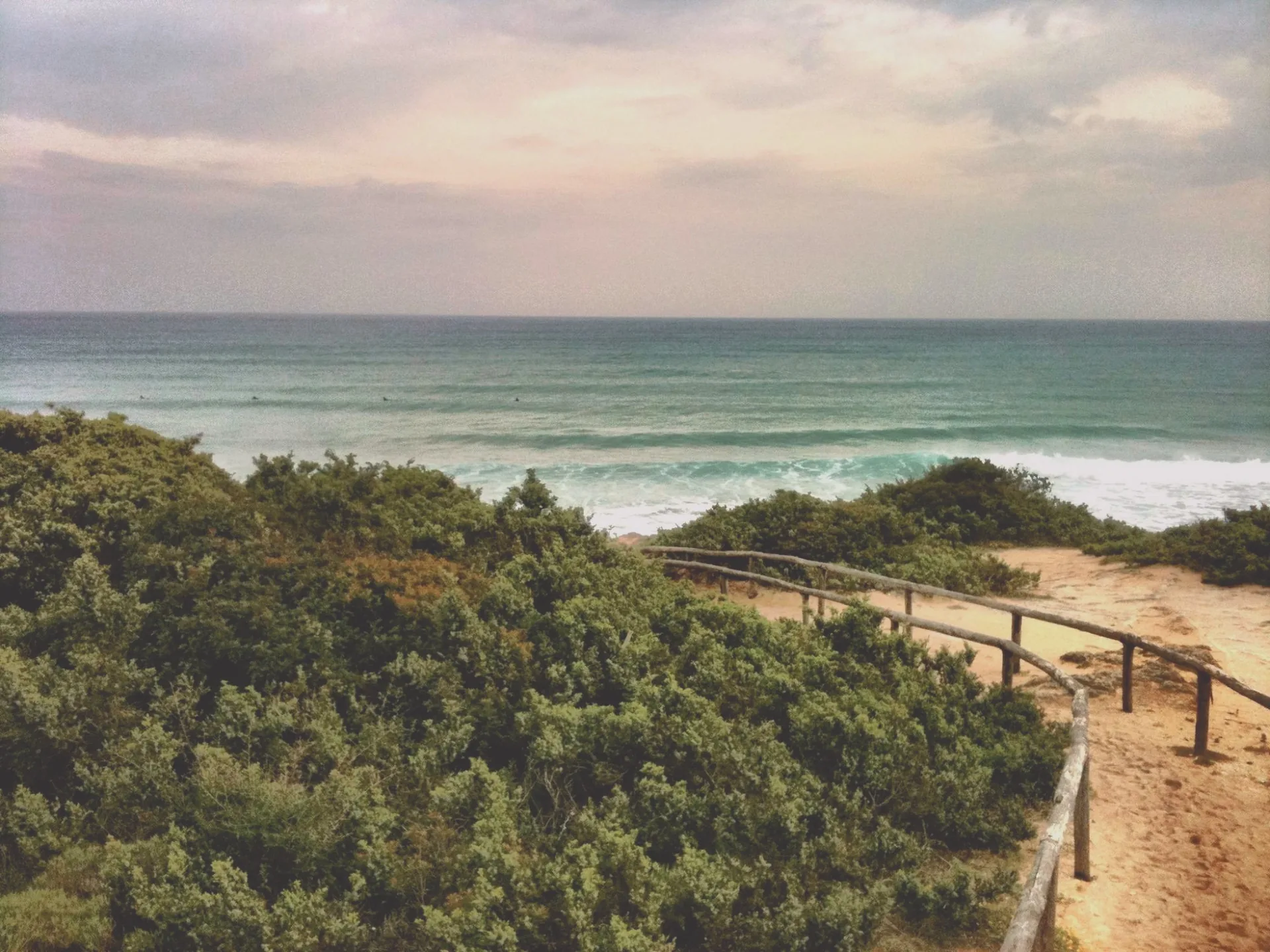
In winter you walk. Along the shore at Campomarino, empty. On the boardwalks among the dunes, which are protected, and where dogs must be kept on a lead. Along the coast to Torre Colimena, and behind the tower to the Salina dei Monaci, where the flamingos can be seen mostly from October to April: at sunset the water turns pink and orange, and they, if they’re there, stay put, dark, on one leg.
Close by is the pinewood, with the arch of the Maviglia at the end of it, and between one olive grove and the next the flocks that come back in winter to graze the new grass. If you meet the shepherd, say hello: in the country, people say hello.
Around you
Around Maruggio: the coast, the wine, the masserie
The beach at Campomarino is one minute away and empty; Punta Prosciutto twenty; Manduria and its Primitivo estates twenty; the adults-only spa at Masseria Palombara about twenty-five. Mostly from October to April, the flamingos can be seen at the Salina dei Monaci. For rainy days there is Taranto, with the MArTA, half an hour away. Nothing is crowded, and what you need is open. Dogs, here, are welcome.
And if you want to go further afield, in winter you can travel the regions of Puglia without the summer crowds: Lecce and the Valle d’Itria are an hour away, Matera under two.
Puglia in winter: questions guests ask
Is the trullo warm in winter?
The house is heated and has a fireplace. A trullo is not insulated, so after long spells of rain it can feel damp: in winter we recommend it for two people.
Can I work remotely from the house?
Yes. The internet is good enough for video calls and a full working day.
What is the minimum stay, and what are the winter rates?
In winter you can stay from 5 to 28 nights. Booking direct, for winter 2026-27 and until 14 March, 14 nights cost €1,554, 21 nights €2,142 and 28 nights €2,604, all included except the tourist tax, excluding 20 December to 6 January.
Can I rent the trullo for a month in winter?
Almost: at Corni di Fiasco the longest stay is 28 nights, four weeks. Booking direct, for winter 2026-27 and until 14 March, 28 nights cost €2,604, all included except the tourist tax (excluding 20 December to 6 January).
Can I bring my dog?
Yes, pets are welcome: tell us when you book. Always supervised, please.
How far is the sea?
The beach at Campomarino di Maruggio is one minute away by car; Punta Prosciutto is twenty minutes.
Do I need a car?
Yes, a car is recommended to explore the coast and the villages around Maruggio, and you can hire one at the airports: Brindisi airport is 50 minutes away, Bari airport 1 hour 45 minutes. The nearest railway station is Manduria, 20 minutes away.
What is the weather like in Puglia in winter?
Mild, for winter. On the Ionian coast, around Taranto, from December to February average highs are around 13 °C and lows between 5 and 7 °C; in November highs are around 17 °C, in March around 15 °C. It rains on six or seven days a month, on average. The wind decides the weather: with the tramontana, which comes down from the Balkans, it gets properly cold; with the scirocco the air is mild and damp.
Is the sea cold in Puglia in winter?
Yes, for swimming: the Ionian Sea at Taranto averages around 18 °C in November, 15 °C in December and 14 °C from January to March. In winter you walk along the shore; swimming is for anyone from the Baltic.
What is there to do in Puglia in winter, around Maruggio?
Around Maruggio you walk the coast: the empty shore at Campomarino di Maruggio, the boardwalks over the dunes, all the way to Torre Colimena. At the Salina dei Monaci, ten minutes by car, the flamingos can be seen mostly from October to April. In November there are the olive harvest and the new oil. Manduria and the Primitivo wineries are twenty minutes by car, with tastings by appointment; the spa at Masseria Palombara, for adults only, is about twenty-five minutes, Taranto and the MArTA half an hour, for rainy days. Lecce and the Valle d’Itria are an hour away, Matera under two. It is all on our map of things to do near Maruggio.
Are shops and restaurants open in winter?
Partly. In Maruggio, five minutes by car, you can do your shopping all year round: in the morning or after 5 pm, because shops close between 1 and 5 pm, and on Sundays the supermarket may close early. On the coast many places close, but not all: the ones open all year round are marked on the map of the area and in the guide we send you before you arrive.
What do people eat in Puglia in winter?
New oil on toasted bread, from November. Broad beans and chicory, pulses, greens from the fields, artichokes, citrus. And between November and Christmas, pettole, fritters of leavened dough that in Salento they call pittule: more about them in our chapter on the food of Puglia.
What festivals are there in Puglia in winter?
From November to March almost every month in Puglia has its own festival, and some have their own dish too. St Cecilia in Taranto, on 22 November, with the bands before dawn and the pettole; the Madonna della Madia in Monopoli, at dawn on 16 December; the Fòcara in Novoli, on the evening of 16 January; Carnival, from Putignano to Gallipoli; St Joseph on 19 March, with the bonfire at San Marzano di San Giuseppe the evening before and the tables in the villages of Salento. Each year’s dates are in the festival calendar.
What is the Quaremma?
It is Lent turned into an effigy: an old woman of rags, dressed in black, who from Ash Wednesday hangs from balconies and from the wires between houses in many villages of Salento, in southern Puglia. She holds a spindle and a bitter orange stuck with seven hen feathers, one for each week until Easter: each week one is pulled out, and when they are gone, at Easter, the Quaremma is burned. For some she is Carnival’s widow, for others his mother.
Winter, the long way.